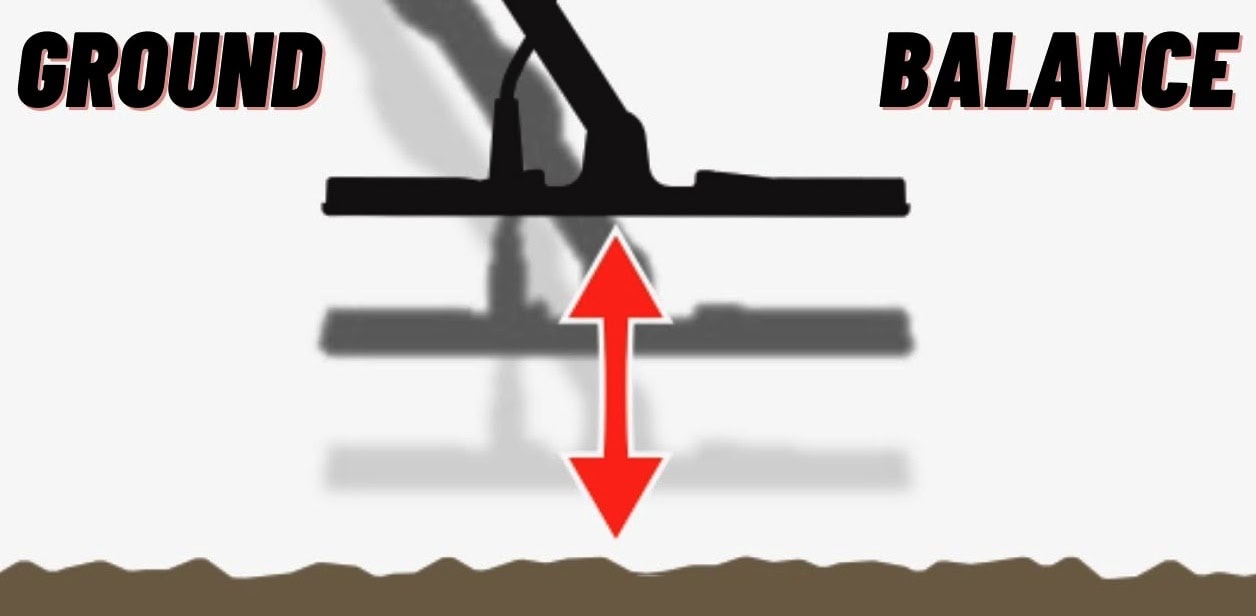
Metal Detector Ground Balance: What It Is and How to Set It
Ground balance is one of the most important metal detector settings to understand, particularly when detecting on mineralised ground.
At its simplest, ground balancing allows your detector to compensate for naturally occurring minerals in the soil that might otherwise produce false signals or interfere with genuine targets.
Some modern detectors handle ground balance almost entirely automatically. Others allow you to choose between automatic, manual and continuously tracking ground balance.
At Metal Searchers, we have spent more than 30 years detecting on a variety of inland and beach locations, and understanding how the detector is responding to the ground is one of the skills that can make a significant difference to a detecting session.
What Is Ground Balance on a Metal Detector?
A metal detector does not respond only to coins, jewellery and other metallic objects.
The ground itself can produce an electromagnetic response.
Naturally occurring minerals such as iron oxides can cause the detector to react as the search coil moves across the surface.
Wet or conductive ground can also produce unwanted responses.
Ground Balance allows the detector to compensate for this background response.
When correctly balanced, the detector becomes less responsive to the ground and better able to identify genuine metallic targets.
Why Does Soil Cause False Signals?
Soil is not electrically or magnetically neutral.
Depending on the location, it can contain varying quantities of:
- Iron minerals
- Magnetite
- Salts
- Conductive moisture
- Mineralised rocks
- Industrial contamination
As the search coil passes over these materials, the detector may interpret changes in the ground as possible targets.
This can result in:
- False signals
- Unstable audio
- Erratic Target IDs
- Reduced effective depth
- Difficulty identifying weak targets
Ground balancing helps reduce these effects.
What Happens If Ground Balance Is Wrong?
An incorrectly ground-balanced detector may become noticeably unstable.
Typical symptoms include:
- Signals appearing when no metal is present
- A response when the coil is raised or lowered
- Excessive chatter
- Unreliable Target ID numbers
- Difficulty hearing deep or weak targets
- Reduced confidence in target responses
One useful test is to raise and lower the search coil over a patch of clean ground.
If the detector produces a distinct response as the coil approaches or moves away from the soil, Ground Balance may need adjustment.
Does Ground Balance Increase Detection Depth?
Not directly.
Ground Balance does not act like a depth control.
Its benefit is that reducing unwanted ground response creates a quieter and more stable detecting environment.
That can allow weak or deep targets to become easier to recognise.
So a correctly balanced detector can perform more effectively at depth, but this is because the target signal is no longer competing as strongly with ground noise.
Do All Metal Detectors Need Ground Balancing?
No.
Some detectors are designed to operate satisfactorily over common soils without the user carrying out a Ground Balance procedure.
Others provide:
- Fixed Ground Balance
- Automatic Ground Balance
- Manual Ground Balance
- Tracking Ground Balance
The correct approach depends entirely on the detector.
Always read the manufacturer's instructions for your particular machine.
What Is Fixed Ground Balance?
A detector with fixed Ground Balance uses a predetermined value selected by the manufacturer.
The user normally does not adjust it.
This simplifies operation and can work very well on relatively mild ground.
Fixed Ground Balance is common on simpler detectors designed for general-purpose detecting.
The disadvantage is that it cannot adapt as precisely to unusually mineralised soil.
What Is Automatic Ground Balance?
Automatic Ground Balance allows the detector to calculate an appropriate Ground Balance setting after the user starts the procedure.
The detector normally analyses the ground while the search coil is raised and lowered over a clean area.
Once the ground response has been reduced sufficiently, the detector stores the calculated value.
This is often the easiest and most appropriate method for beginners.
What Is Manual Ground Balance?
Manual Ground Balance allows you to adjust the Ground Balance value yourself.
You normally raise and lower the search coil while listening to the ground response.
Depending on the detector:
- A low tone may indicate that the Ground Balance value should be increased.
- A high tone may indicate that the value should be decreased.
You continue adjusting until the response to the ground is minimised.
Manual adjustment is particularly useful when:
- Automatic Ground Balance struggles
- The ground is unusually mineralised
- You want very fine control
- You are making minor corrections to an automatic setting
What Is Tracking Ground Balance?
Tracking Ground Balance continuously monitors changes in the ground while you are detecting.
The detector automatically adjusts the Ground Balance setting as the mineralisation changes.
This can be useful where the soil varies considerably across a site.
For example, you may move from:
- Light soil
- To iron-rich soil
- To mineralised patches
- To wetter ground
without stopping to manually rebalance.
When Is Tracking Ground Balance Useful?
Tracking can be particularly useful on:
- Highly variable soil
- Mineralised farmland
- Goldfields
- Sites containing scattered mineralised rocks
- Ground where conditions change frequently
However, it is not always the best choice.
Some manufacturers warn that excessive tracking in difficult ground can potentially influence responses from small or deep targets.
Therefore, tracking should be treated as another tool rather than something that must always be switched on.
Automatic, Manual or Tracking Ground Balance?
A simple rule for beginners is:
Automatic Ground Balance
Use this when you want the detector to determine the appropriate setting for the current soil.
Manual Ground Balance
Use this when you want greater control or the automatic procedure is not producing a satisfactory result.
Tracking Ground Balance
Use this when the ground conditions are changing significantly as you move across the site.
The exact behaviour varies between manufacturers and detector models.
How to Ground Balance a Metal Detector
The exact button sequence differs between machines, but the underlying process is often very similar.
Step 1: Find Clean Ground
Find an area without any obvious metallic targets.
Sweep the coil over the area first.
If you hear a target response, move elsewhere.
Ground balancing over buried metal can produce an incorrect result.
Step 2: Select the Ground Balance Function
Open the Ground Balance setting according to your detector's instructions.
Step 3: Hold the Coil Parallel to the Ground
Keep the search coil reasonably level.
Do not tilt it dramatically as you move it.
Step 4: Raise and Lower the Coil
Pump the search coil smoothly between a position several centimetres above the ground and close to the surface.
Do not repeatedly strike the ground with the coil.
Step 5: Listen to the Ground Response
With automatic Ground Balance, the detector normally calculates the appropriate value.
With manual Ground Balance, listen to how the audio changes as the coil moves toward and away from the soil.
Step 6: Continue Until the Ground Response Is Minimal
A properly balanced detector should produce little or no significant response purely from raising and lowering the coil over clean ground.
Step 7: Start Detecting
Once balanced, begin your search.
If ground conditions later change noticeably, repeat the procedure.
How High Should You Pump the Coil?
This varies between detectors.
A common procedure is to move the coil between approximately:
15–20 cm above the ground
and
around 2–3 cm above the surface.
Do this smoothly while keeping the coil reasonably parallel to the soil.
Always follow the distances specified in your detector's manual because manufacturers use slightly different procedures.
Ground Balance on Farmland
Farmland can vary considerably.
You may encounter:
- Clay
- Sandy soil
- Iron-rich soil
- Chalk
- Wet ground
- Recently disturbed ground
- Fertiliser contamination
- Burnt areas
Do not assume that a Ground Balance value obtained in one field will be ideal in another.
If you move between fields or notice a significant change in detector stability, rebalance.
Ground Balance on Pasture
Pasture can sometimes be relatively stable, but the underlying geology still matters.
Older pasture can also contain:
- Iron contamination
- Agricultural debris
- Burnt material
- Mineralised stones
If your detector runs quietly at its default setting, there may be no reason to keep adjusting it unnecessarily.
If the machine becomes unstable, Ground Balance is one of the first settings worth checking.
Ground Balance on Ploughed Fields
Ploughed soil can produce rapidly changing coil height and target orientation.
This alone can make the detector sound more active.
Try to keep the search coil following the contour of the soil as closely as practical.
Where mineralisation is present, an accurate Ground Balance can help distinguish genuine target responses from changes in soil conditions.
Ground Balance on Beaches
Beach detecting presents different challenges.
Dry sand is often relatively easy.
Wet salt sand is electrically conductive and can produce a strong ground response.
Modern beach-capable detectors are generally designed to compensate for this.
Some provide specialised Beach modes that alter:
- Frequency behaviour
- Salt compensation
- Ground Balance characteristics
- Sensitivity
- Signal processing
Do not assume that the inland Ground Balance procedure should be used unchanged on wet salt sand.
Follow the manufacturer's beach-mode recommendations.
Should You Ground Balance on Wet Sand?
That depends on the detector.
Some manufacturers recommend particular Ground Balance settings or procedures in Beach mode.
Others design their beach profiles so that very little manual intervention is necessary.
The correct answer is therefore:
Follow the instructions for your particular detector and Beach mode.
A setting that works extremely well on inland soil may be inappropriate on conductive wet salt sand.
What Are Hot Rocks?
Hot rocks are stones or pieces of mineralised material that produce a response from the detector because their mineral content differs significantly from the surrounding ground.
They can sometimes sound surprisingly similar to genuine targets.
Good Ground Balance can reduce the response from many mineralised rocks, although particularly strong hot rocks may still produce signals.
Learning their characteristic response is part of gaining experience on mineralised sites.
Can Ground Balance Remove Good Targets?
Potentially, if used incorrectly.
Ground Balance is designed to remove responses associated with the ground.
However, aggressively changing Ground Balance or using certain forms of tracking under difficult conditions can sometimes influence responses from weak targets.
This is why you should avoid constantly adjusting settings without understanding what effect they are having.
Don't Ground Balance Over Metal
This is one of the most common Ground Balance mistakes.
Always check that the area beneath the coil is free from metal before beginning the procedure.
If there is a buried target directly beneath the search coil, the detector may attempt to compensate for the target as though it were part of the ground.
Ground Balance and Sensitivity Are Different
Ground Balance and sensitivity solve different problems.
Sensitivity determines how strongly the detector responds to signals.
Ground Balance compensates for the response generated by the ground itself.
If the detector is unstable, don't automatically reduce sensitivity.
First consider whether the cause might be:
- Ground mineralisation
- Electromagnetic interference
- Incorrect Ground Balance
- Excessive sensitivity
- Search coil movement
- Electrical interference
Diagnose the cause before adjusting multiple settings.
Ground Balance and Noise Cancel Are Different
These are also often confused.
Ground Balance
Deals primarily with unwanted responses from the soil or ground.
Noise Cancel
Deals primarily with electromagnetic interference from external electrical sources.
These may include:
- Power lines
- Buildings
- Other detectors
- Radio transmitters
- Electrical equipment
If the detector is unstable, both are worth considering.
Ground Balance and Discrimination Are Different
Discrimination decides which types of detected metallic targets are accepted or rejected.
Ground Balance compensates for the ground itself.
They serve completely different purposes.
A detector can be perfectly ground-balanced while still responding to unwanted iron targets if your discrimination settings allow them.
When Should You Re-Ground Balance?
Consider repeating Ground Balance when:
- Moving to a different field
- Soil type changes
- The detector becomes unusually noisy
- Ground mineralisation appears different
- Moving from dry to wetter soil
- Changing search mode
- Changing frequency where required by the detector
- Entering strongly mineralised ground
You don't necessarily need to rebalance every few minutes.
Respond to actual ground conditions.
How Often Should You Ground Balance?
There is no universal interval.
Some detectors with tracking Ground Balance can automatically compensate continuously.
Other machines may only need balancing:
- At the beginning of the session
- When moving to a new area
- When ground conditions noticeably change
Minelab advises users of manual Ground Balance detectors to balance at the beginning of a hunt and rebalance periodically where necessary.
A Practical Ground Balance Test
If you are unsure whether your detector is balanced:
- Find clean ground.
- Hold the coil several centimetres above the surface.
- Lower it toward the ground.
- Raise it again.
- Listen carefully.
If you hear a strong repeatable audio response purely from the movement toward and away from the soil, Ground Balance may require adjustment.
Learn What Your Ground Sounds Like
One thing experience teaches you is that the detector is not only communicating information about buried metal.
It is also telling you about the ground.
Spend some time listening to what happens when you:
- Raise the coil
- Lower the coil
- Sweep mineralised soil
- Move across wet patches
- Pass over hot rocks
- Change Ground Balance
The better you understand the ground response, the easier it becomes to recognise genuine targets.
Don't Chase a Particular Ground Balance Number
The Ground Balance value itself is not a measure of how good a detecting site is.
For example, a value of 20 is not automatically “better” than a value of 70.
It simply represents the detector's calibration for that particular ground and operating mode.
Different detectors also use completely different Ground Balance scales.
Do not compare numbers between manufacturers.
Ground Balance Can Change With Frequency
On some detectors, Ground Balance values can vary depending on whether you are operating in:
- Single frequency
- Multi-frequency
- Different Search Modes
Therefore, a value obtained in one frequency or mode may not necessarily transfer directly to another.
Again, follow the manufacturer's instructions.
Common Ground Balance Mistakes
Ground Balancing Over a Target
Always find clean ground first.
Assuming Maximum Sensitivity Will Fix the Problem
Excessive sensitivity can make ground noise worse.
Constantly Rebalancing Without Reason
If the detector is stable and operating correctly, you may not need to keep changing the Ground Balance.
Confusing Ground Noise With EMI
If interference is coming from power lines or electrical equipment, Ground Balance will not fix the underlying problem.
Using Somebody Else's Ground Balance Number
A Ground Balance value that works perfectly on another detectorist's site may be completely wrong for yours.
Not Reading the Detector Manual
Ground Balance procedures vary significantly between machines.
Our Recommended Approach for Beginners
If your detector provides automatic Ground Balance, start with that.
A good beginner routine is:
1. Select your normal search mode.
2. Perform Noise Cancel if available.
3. Find clean ground.
4. Carry out Auto Ground Balance.
5. Set sensitivity to a stable level.
6. Begin detecting.
7. Rebalance only when conditions indicate that it is necessary.
Once you understand how the detector behaves, experiment with manual Ground Balance and Tracking modes.
Frequently Asked Questions
What does Ground Balance do on a metal detector?
Ground Balance compensates for the electromagnetic response produced by minerals in the soil, helping reduce false signals and allowing genuine targets to be heard more clearly.
Do I need to Ground Balance every time I detect?
Not necessarily. It depends on the detector and ground conditions. Some detectors work effectively with fixed or automatic settings, while others should be balanced at the start of a session.
Is automatic Ground Balance good enough?
For many situations, yes. Automatic Ground Balance is an excellent starting point and is often the method recommended by manufacturers.
Is manual Ground Balance better?
Not automatically. Manual Ground Balance provides greater control but requires more understanding from the user.
What is Tracking Ground Balance?
Tracking Ground Balance continuously updates the detector's Ground Balance as soil conditions change.
Does Ground Balance improve depth?
It does not directly increase depth, but reducing ground noise can make weak or deep targets easier to detect.
Why does my detector beep when I lower the coil?
A response generated purely by moving the coil toward the ground can indicate that the detector is responding to mineralisation and may require Ground Balance adjustment.
Should I Ground Balance on a beach?
Follow your detector manufacturer's instructions. Wet salt sand behaves differently from inland soil, and many detectors use specialised Beach modes.
Can I use somebody else's Ground Balance setting?
Generally, no. Ground Balance depends on your local soil, detector, frequency and operating mode.
Should I use Tracking Ground Balance all the time?
Not necessarily. Tracking is useful where ground conditions vary, but fixed or automatically established Ground Balance can be preferable in more uniform conditions.
Final Thoughts
Ground Balance is one of those detector settings that can initially sound more complicated than it really is.
The principle is simple:
your detector should respond to buried metal rather than constantly responding to the ground itself.
If the ground is producing excessive noise, Ground Balance helps the detector compensate for it.
For beginners, automatic Ground Balance is usually an excellent place to start.
As your experience grows, learning manual and Tracking Ground Balance can give you greater control when detecting more challenging sites.
Most importantly, don't become obsessed with Ground Balance numbers.
Listen to the detector.
Learn how it behaves over clean ground.
Understand the difference between ground noise, electrical interference and genuine target responses.
That knowledge will ultimately make you a more effective detectorist than simply copying somebody else's settings.
Happy detecting!