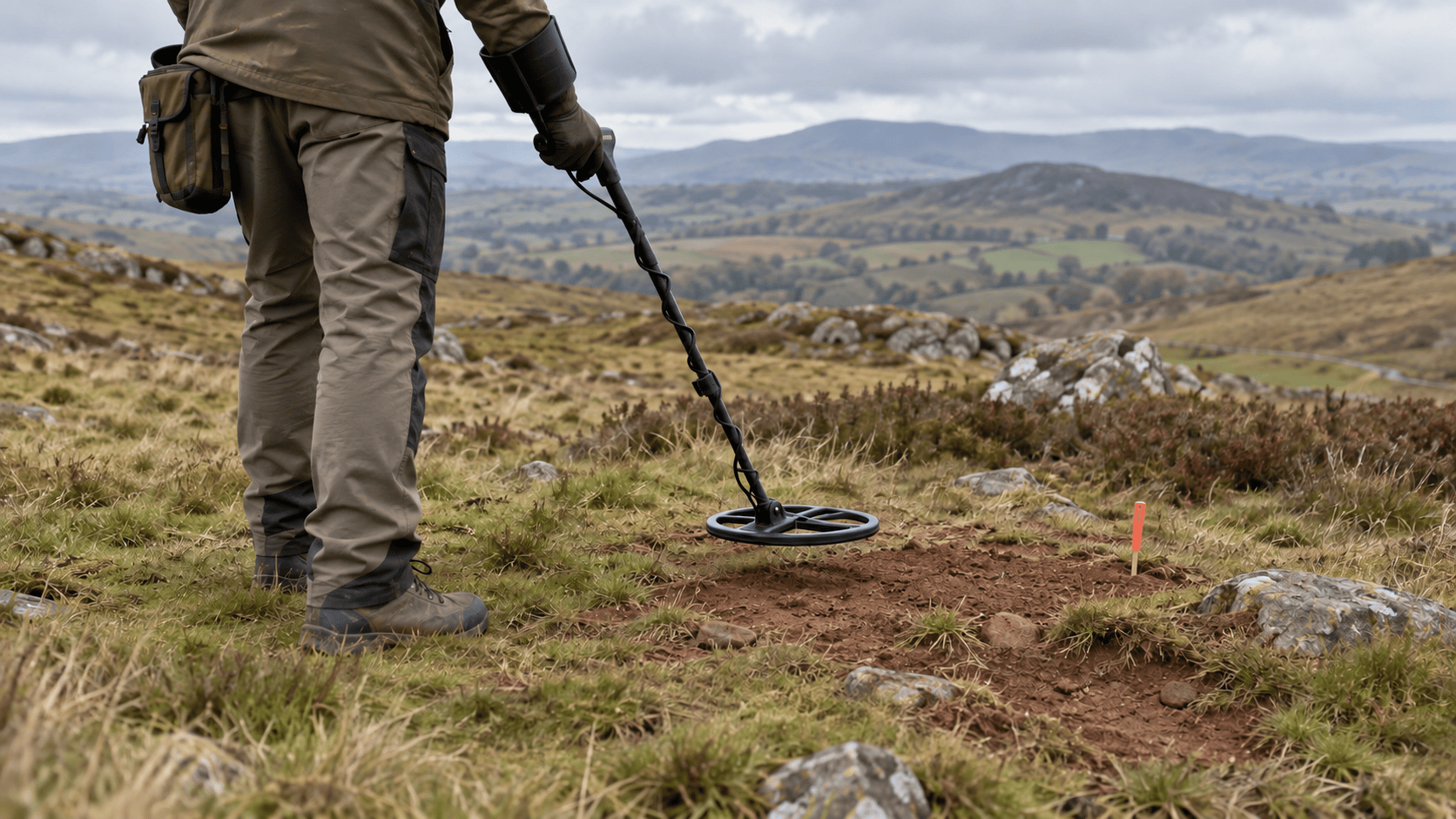
How to Ground Balance the Minelab Manticore on Mineralised Soil
Mineralised soil can produce audio responses that follow changes in the ground rather than a buried metal object. On red, stony or variable ground, these responses may obscure faint targets or encourage unnecessary digging.
This exercise shows how to recognise ground feedback, perform the Manticore’s automatic Ground Balance procedure and compare it with Ground Balance Tracking. The goal is not to find a universal balance number; it is to learn which option gives stable performance at that particular location.
These are conservative starting points. Local mineralisation, moisture, electromagnetic interference, firmware, coil selection and user technique may require adjustment.
Suitable terrain and conditions
Use a permissioned pasture, upland field or previously disturbed area containing visibly variable soil, reddish patches or natural stone.
Avoid protected land, scheduled or sensitive archaeological areas, livestock, crops, unstable slopes and locations where digging is prohibited.
Obtain permission from the landowner or responsible authority and confirm the permitted recovery method. Heritage, treasure and finds-reporting requirements vary worldwide; always follow the law for the country or region where you detect.
Conservative starting settings
- Search Mode: All-Terrain General
- Frequency: Multi-IQ+
- Sensitivity: 17–21, lowering it if operation remains unstable
- Recovery Speed: Mode default
- Ferrous Limits and discrimination: Mode defaults
- Ground Balance: Begin at the current or default fixed value
- Coil: M11 or another compatible Manticore coil
- Audio: Familiar tones with enough volume to hear subtle ground response
Run Noise Cancel with the coil stationary and clear of metal. Move well away from electric fences and buried or overhead services. Remove metal tools from the test area.
Exercise: fixed balance versus Tracking
1. Locate genuinely clean ground
Search a patch approximately one metre square from two directions. Choose an area without a compact, repeatable target response. Ground balancing directly above metal will produce a misleading result.
Place a removable non-metallic marker beside the clean patch, outside the coil’s pumping area.
2. Listen before balancing
With Ground Balance Tracking switched off, raise and lower the coil between approximately 2 and 15 centimetres above the soil without touching it. Use a smooth vertical movement and keep the coil level.
Listen for a repeatable sound as the coil approaches or leaves the ground. A broad response linked to coil height, rather than a localised point, is characteristic of ground feedback.
Notice whether it becomes stronger over darker, redder or stonier soil.
3. Perform an automatic Ground Balance
Open the Ground Balance setting and use the Manticore’s automatic balancing command described in the current instruction manual.
While holding the command, pump the coil smoothly over the clean patch until the displayed value settles and the ground response reduces. Release the control and note the resulting value.
The precise control presentation may differ with interface or firmware revisions, so follow the on-screen command and current Minelab manual rather than relying on an old screenshot.
Repeat the coil-height test. If the ground response is quieter without losing general stability, the balance has helped. If the detector remains noisy everywhere, reduce Sensitivity by two points before making further Ground Balance changes.
4. Walk a fixed-balance test line
Ensure Tracking is switched off. Walk a 15-metre line crossing at least two visibly different soil patches. Sweep slowly with the coil low and level.
Record:
- The number of broad, ground-like responses
- Whether false signals appear when soil colour or texture changes
- The clarity of compact, repeatable target responses
Do not recover targets yet. Mark one or two genuine-looking signals so you can check the same targets later.
5. Repeat with Ground Balance Tracking
Return to the beginning, enable Ground Balance Tracking and walk the identical line at the same speed and Sensitivity.
Tracking continually adapts the balance as the ground changes, so give it several normal sweeps before judging the result.
Avoid repeatedly sweeping a marked target while Tracking is learning. Move across the test line naturally, then disable Tracking before making numerous investigative passes over one signal.
Compare the ground noise and clarity of the marked targets. If Tracking gives noticeably calmer operation across changing soil, it may be useful for that section. If the ground is uniform and the fixed balance is already quiet, leaving Tracking off provides a consistent reference.
Interpreting the results
Ground response tends to be broad, linked to coil height and associated with an area or soil transition.
A metal target more often has a discernible centre and can usually be cross-swept, although mineralisation may distort its Target ID and 2D trace.
Do not regard a particular Ground Balance number as inherently good or bad. It represents the detector’s adjustment for that ground and may change elsewhere.
Repeat the clean-ground check after moving to a visibly different soil type or whenever ground noise increases.
Why this works
Pumping the coil reveals whether the soil itself is generating a response. Comparing the same marked route with fixed balance and Tracking keeps the terrain, targets and Sensitivity constant, making the effect of the balancing method easier to hear.
Common mistakes
- Ground balancing over a buried target
- Touching the soil while pumping the coil
- Raising and lowering the coil at different angles
- Increasing Sensitivity to overcome mineralisation
- Changing several settings during the comparison
- Repeatedly sweeping one target while Tracking is active
- Treating the Ground Balance number as a target indicator
Before you leave
- Permission, boundaries and recovery rules confirmed
- Noise Cancel completed away from metal
- Clean ground checked from two directions
- Initial ground response observed before balancing
- Automatic Ground Balance completed
- Fixed and Tracking passes made over the same route
- Marked targets rechecked with Tracking disabled
- Every permitted recovery refilled and restored
- Markers and sharp waste removed safely
- Reportable finds handled under applicable local law
P.S. Please leave a comment below, if you have any other tips, which may help other detectorists, thanks